|
Louisiana Bayou Sac-a-lait
Crappie are abundant in the waterways that criss-cross
the flooded swamp.
by Larry Larsen
Two twitches of the rod tip was all it took for a pan-size crappie to tug back. The small bobber disappeared into the stained swamp water and the wispy rod bent
into a hook-shape. I lifted the 3/4 pound fish into the boat and glanced forward at my guide for the day, Charlie Jeanmard. He also was hoisting in a crappie of about the same proportions.
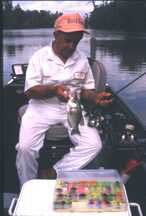 Ten fish in the first 15 minutes. Not a bad start, I thought. "The Sac-a-lait here are not
running large enough," stated the veteran crappie fisherman. "We need to move." Ten fish in the first 15 minutes. Not a bad start, I thought. "The Sac-a-lait here are not
running large enough," stated the veteran crappie fisherman. "We need to move."
For 35 years, the now-retired Lafayette businessman has been fishing the Atchafalaya
Basin and catching lots of "sac-a-lait," as the cajuns around the swamp call the crappie. So
, who's not to listen to Jeanmard. He used a small handheld walkie-talkie to tell his friend in a nearby boat that we were moving. Leroy Mouton, his long time fishing companion,
agreed that the larger crappie could be elsewhere, so he stowed his rod and followed us.
We motored along the bayou canals through some of the prettiest scenery found in southern Louisiana. We moved through river and creek channels and through cuts that
parted a shallow-looking flooded swamp. The depth in the basin, though, can be deceiving. In the swift Atchafalaya River, depths range from 30 to 90 feet, surprisingly deep. Just
off the river are numerous bayous and small tributaries that form the Atchafalaya Basin. The water level back in the basin is always high, according to the locals, and sometimes it
is flooded. As a result, plenty of backwater areas exist just from the natural river levels.
|
The basin is dangerous to fish if you don't know what you're doing. When you
are fishing in the flooded swamps, you may find that area is only two feet deep. But, in the bayous and tributaries, you can often find 10 to 20 feet of water.
The majority of the crappie fishing takes place in the bayous and smaller creeks and canals, away from the deep river channels
|
|
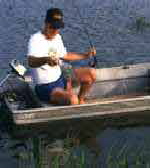
Jeanmard shut off his outboard and we coasted to a stop along a cypress-lined creek. He readied his 8 1/2 foot rod and flipped his small jig near the grass-surrounded
cypress knees. The tip jerked downward and he swung another palm-size crappie into the boat. My first flip against the overgrown cover just off the bank resulted in
an even smaller crappie. Jeanmard and I continued to pick up crappie a variety of sizes along the bank.
Finally, Jeanmard caught one that would have easily weighed over a pound, and ten feet further down the bank, my rod was doubled over by a heavy fish. It easily pulled
drag from the small Zebco UL 4 reel spooled with six pound test line. I carefully fought the 7 pound drum to the waiting landing net. The tussle was repeated three
more times that day with drum almost as large.
Atchafalaya Basin Results
The hand-built jig pole worked perfectly on those fish, a couple of catfish, four bass,
several sunfish and about 70 crappie ranging up to about 1 1/4 pounds. Jeanmard orders the long, limber graphite rod blanks with a No. 5 or 6 tip and threads the line
from the spincast reel through the hollow blank. The reel's function is mostly to hold line and to offer a drag when a larger crappie or other heavy fish is hooked.
Jeanmard's equipment and tactics for the Atchafalaya Basin have evolved from his constant year-round exposure.
He and Mouton originally employed small shiner minnows in the basin, but switched to jigs in the early 1970s. Since then, they have used jigs exclusively.
In fact, Jeanmard's daughter makes the area's most popular jigs. Becky's Custom-Made Jigs (204 Ransome St.,
Lafayette, LA 70501; 318/234-2218) are a hand-tied hair jig with a balanced lead head. They carry 1/64, 1/32 and
1/16 ounce jigs, but Jeanmard prefers the middleweight for springtime action. The 1/64 ounce is also effective on the basin crappie at that time when the fish prefer a smaller jig.
In April, the basin water is usually high, and crappie are numerous outside of the basin, either in the marsh or the
Stevenville area. If the water level in the basin is low from a relatively dry spring, the crappie will be thick in the basin.
 Getting Your Bearings Getting Your Bearings
The Atchafalaya Basin is located south of Interstate 10 and stretches from Lake Arthur
to Morgan City, or about 100 miles. The basin is 18 miles at its widest point and is an authentic swamp. When the basin's water is high, most of the swamp is under water.
The channels in the basin and swamp are not well marked, so it is advisable to fish with a local or a guide who knows where they are.
"People get lost out there every year," warns Jeanmard in his cajun accent. "You're going
into a wild area, so you need to take plenty of gas in your boat and a good map. Those who are unfamiliar with the basin can use their head and a good compass to keep from
getting lost. A lot of people don't have a compass or don't think about their course, though."
When crappie are spawning, Jeanmard suggests that you fish the edges of the cover that lies in fairly shallow
water. He'll normally use a bobber even in waters two feet deep or less. The fish are normally on the edge in shallow water.
The largest crappie typically taken in the bayous weigh about 2 1/2 pounds, and the limit is usually generous.
Jeanmard and Mouton catch a limit just about every time they go fishing, which is three or four times each week.
Check out the bayous and remember that good stringers of crappie here will have fish that average one to 1 1/4 pounds!
Bayou Tactics
"We use a combination of black body and chartreuse wing/tail jig in the spring, says Jeanmard. "We use black &
orange, blue and white, and black & gray with a tinsel body. The latter is real popular. It's called the minnow.
Another good color for fishing in bayous called the bumblebee, is black & yellow."
Another effective tactic for catching Sac-a-lait in the bayous is trolling. The fish often hang out in the middle of the
canals for a couple of weeks, but some years that pattern lasts for two or three months. Trolling is the most productive method then.
During years of unusually high water over a long period, the pattern can change. Most bayous are affected by rain
runoff, not necessarily that rainfall in the immediate area. The water clarity changes and may get muddy with
runoff, particularly if that runoff is through reddish mud country. When that happens, if you can find an area that's
clear, you might find some fish. Generally though, the crappie won't be feeding in the muddy areas.
Editor's Note: Click if you want help with lodging or flights. This article is a partial excerpt from the book, "Crappie
Tactics". The longer book chapter contains additional information on water color lure selections, location evaluation, weather and seasonal movements.
|