|
"Scaling" The Matterhorn Region
 In the heart of the Swiss Alps, the beautiful Matterhorn Region is a little over 90 miles long. Close to 50 mountain peaks surround the
Rhone River valley, and the fertile grounds are home to Swiss wine and fruit growers. It is obvious why this region is the highlight of many
vacationers in Switzerland. The famous peak and the unique world of glaciers and mountains surrounding the valley by the same name truly
steal the show. The prime destination here in the southwestern part of the country is the village of Zermatt, which lies in the Matter Valley at
the center of the scenic amphitheatre of glaciers and mountains. In the heart of the Swiss Alps, the beautiful Matterhorn Region is a little over 90 miles long. Close to 50 mountain peaks surround the
Rhone River valley, and the fertile grounds are home to Swiss wine and fruit growers. It is obvious why this region is the highlight of many
vacationers in Switzerland. The famous peak and the unique world of glaciers and mountains surrounding the valley by the same name truly
steal the show. The prime destination here in the southwestern part of the country is the village of Zermatt, which lies in the Matter Valley at
the center of the scenic amphitheatre of glaciers and mountains.
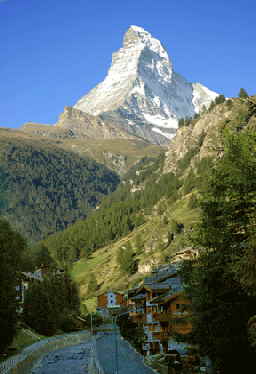
In Zermatt, the impressive snow-capped Matterhorn at 14,680 feet easily towers over the artistically-attractive village and all other 38
mountain peaks around. Just as the Liberty Statue is synonymous with New York, the Matterhorn is synonymous with Switzerland. Even
better, cars are not allowed in Zermatt. Some hotels offer small electric buses for luggage and for guests with walking disabilities; horse
-drawn carriages are also used for some inner-village transportation. All vehicle traffic must park several miles away and take the train into
the village. One tip for those that drive is that you can get unlimited free parking at the Visp train station. For information on the car-free
village of Zermatt, check out http://www.zermatt.ch/matterhorn-group.
After arriving in Zermatt, we settled into the very comfortable 84-room Zermatterhof Hotel. The five star historic property was opened in 1879
and was one of the first hotels in the village. Fortunately, the local community has made certain that the small, quaint village retains its
personality and culture as new construction continues in this popular destination. This doesn't prevent hotels like the Zermatterhoff from offering the most modern accommodations,
including internet access. Just a 5-minute walk from the train station, the hotel's central location is ideal. For
information on the Zermatterhof hotel, visit http://www.matterhorn-group.ch/en/zermatterhof/hotel/index.php.
Today, there are over 100 small hotels and over 100 restaurants in Zermatt to sleep and feed those international visitors that hit the mountains during the
daylight. Several of the innumerable hiking paths that traverse the valley can be accessed within a few minutes walk from most of the village's hotels. From easy walking to mountain biking to
extreme hiking, spending time in the Matter Valley outdoors is a "must do" for any visitor. In the winter, there is
skiing, snowboarding, snow tubing, snow cross and snow cart among other sport activities. In warmer weather, there's canyoning, mudbiking and other exercising means of sport.
Six drag-lifts and a cable-car give access to guaranteed snow year around and the highest summer ski area in
the Alps. Four breathtaking peaks are accessible by either cog-wheel train or cable car. The 3-day Peak Pass, at
approximately $150 per person, is the best way to have unlimited access to all the viewpoints. The
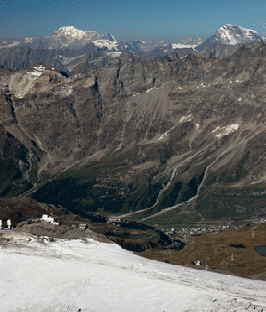 ride to Rothorn is first by cog-wheel and then by cable car on up to 7,500 feet
elevation. The middle station on your way to Rothorn is called Sunnegga, which means "sunny corner". A gondola holding up to four people then takes you from Sunnegga up to Blauherd and its picnic
facilities at 8,490 feet in 7 minutes. From there, a panoramic cable car takes you up to the 10,170-foot-tall Rothorn, which offers the most photogenic side of the Matterhorn. ride to Rothorn is first by cog-wheel and then by cable car on up to 7,500 feet
elevation. The middle station on your way to Rothorn is called Sunnegga, which means "sunny corner". A gondola holding up to four people then takes you from Sunnegga up to Blauherd and its picnic
facilities at 8,490 feet in 7 minutes. From there, a panoramic cable car takes you up to the 10,170-foot-tall Rothorn, which offers the most photogenic side of the Matterhorn.
For those who don't like to dangle from a cable, the first stage to the Gornergrat mountain peak can be visited only by cog-wheel train,
offering fantastic views and a restaurant at the top for lunch. Recent expansion of this scenic route now includes a cable car to the highest point at Stockhorn, which is at 11,170 feet.
The Matterhorn Express is the newest cable car, taking only 12 minutes to Schwarzsee to reach 8,470 feet and the foot of the majestic
Matterhorn. This spot offers the closest view of the Matterhorn and the starting point for climbing the impressive peak. A mountain lake
reflects a small chapel and the beautiful mountain scenery. From here, a 3-hour hike back to the village passes below the north face of the
Matterhorn and offers some of the most beautiful scenery in the area.
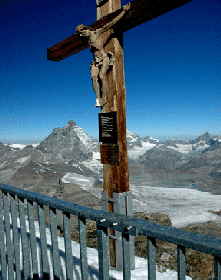 But the highlight for soft adventure seekers is the Matterhorn Glacier and a 40
-minute scenic cable car ride in three stages. The first gondola with 8 seats takes you up to the first station called Furi. A cableway for 120 people
continues to station Trockener Steg, the final stopping point for many people due to the altitude and thin air. The final ride on the highest cable car in the
world reaches the Klein Matterhorn at 12,710 feet where the thin air dictates that some visitors walk around the area slowly in order to avoid becoming light headed. But the highlight for soft adventure seekers is the Matterhorn Glacier and a 40
-minute scenic cable car ride in three stages. The first gondola with 8 seats takes you up to the first station called Furi. A cableway for 120 people
continues to station Trockener Steg, the final stopping point for many people due to the altitude and thin air. The final ride on the highest cable car in the
world reaches the Klein Matterhorn at 12,710 feet where the thin air dictates that some visitors walk around the area slowly in order to avoid becoming light headed.
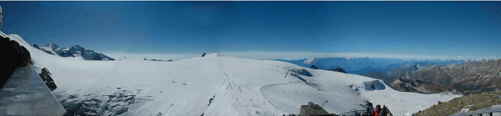
Once at the station, visitors can take an elevator and climb stairs to the 250-foot high platform on top that allows the best view of the world class,
panoramic spread of mountains, glaciers and permanent snow. It is here on Europe's highest viewing platform where you can see the Italian and French
Alps in the distance, as well as half a dozen glaciers and indescribable scenery of the Swiss Alps. At a nearby mountain top, we could see many hikers
utilizing a rope for safety continuing their ascent towards the top of the Little Matterhorn. During skiing season, newcomers often inadvertently end up in
Italy, since many of the skiing trails at the top of the mountain are shared by both countries.
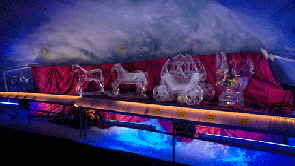 An interesting ice pavilion is carved into the glacier on top of this mountain. An icy footpath and a handy rope help to navigate the
downward trail into the "ice grotto" some 50 feet below the surface. The narrow path suddenly opens into a massive ice cave where smaller caves are carved out. Many had interesting displays
of ice sculptures to view. As is common in Switzerland, a free wine offering at the "grotto bar" is included during the visit to the glacier cave. An interesting ice pavilion is carved into the glacier on top of this mountain. An icy footpath and a handy rope help to navigate the
downward trail into the "ice grotto" some 50 feet below the surface. The narrow path suddenly opens into a massive ice cave where smaller caves are carved out. Many had interesting displays
of ice sculptures to view. As is common in Switzerland, a free wine offering at the "grotto bar" is included during the visit to the glacier cave.
After reaching the peak and enjoying the memorable views, we headed back down to the Furi station where we had lunch on an outdoor veranda overlooking the Matterhorn and mountain
scenery. We enjoyed viewing the cable cars on their way up and down the mountain while we feasted on a lunch
of Rossti and eggs (eggs with sausage and hash browns). With a full stomach, we decided to take an easy, 45
-minute long walking trail down the mountain to Zermatt. This was by far the best way of getting an upfront and
close experience of the wonderful scenery and the beautiful quiet of the countryside.
In one area, cows with their neck bells softly ringing grazed in a small pasture. It was such a relaxing moment to
embrace! The path took us through many small vintage cottages (called mazots) used for drying meat. We
learned that the large round shale stone "guards" at the corner pilings of each building were in place to prevent
mice from climbing into the structures. The original buildings also have shale roofs which easily withstand the heavy snows. Even some of the modern buildings in the area have shale roofs.
Evenings in the village of Zermatt can be as enchanting as the daytime activities are exciting. World-famous
musicians schedule concerts at the Reffelalp Chapel in late summer. During our visit, we were invited to listen to
Emmanuel Pahud, the solo flautist from the Berliner Philharmonic Orchestra. It was truly a magical experience
listening to the live small chamber orchestra, in a several hundred year old chapel that is now surrounded by a
community of hotels, chalets, apartments, shops, restaurants and other mountain structures. We could have just
as easily been listening to the flautist at any major concert hall in the world. While the beauty of the mountains enchants the eyes, the music enchanted the spirit.
Read Next Story
|