|
Amazon's Isolated Xeriuini River Monsters
1,600,000 areas of Explosive Peacock Bass Surround Macaroca!
By Larry Larsen
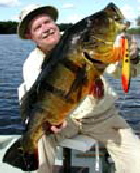 It was a typical explosive moment. My lobbed plug hitting the surface of the water seemed to set off the
detonation. I leaned back hard on the rod as the giant peacock bass blasted off for the flooded forest… with my eight-inch topwater plug in its mouth. It was a typical explosive moment. My lobbed plug hitting the surface of the water seemed to set off the
detonation. I leaned back hard on the rod as the giant peacock bass blasted off for the flooded forest… with my eight-inch topwater plug in its mouth.
"Va a media! Va a media!" my friend and fishing operation outfitter Wellington Melo shouted at our guide trying to get him to move the boat quickly to the middle of the
lagoon. "Muito rapido! Muito rapido!"
I put as much pressure on the fish, rod, line and reel as I could, as our fishing craft headed away from the trees, but the peacock bass bulled into them. I turned the
big fish just in time for it to become entangled in brush at the edge of the flooded jungle. When almost all hope was lost, the fish freed itself of the limbs and swam out of the obstruction.
Albeit somewhat abraded, my heavy 100-pound test line held, as I forced the fish back into open water.
The battle was not over yet. Three acrobatic jumps to dislodge the over-sized, 8-inch long Woodchopper
topwater and another three powerful runs toward the cover, each time pulling a very tight drag, ensued. I
snubbed the fish short of the entanglements again and again, but it did not give up easily. I finally conquered the fish and Wellington grabbed its lower lip with my Boga Grip.
Quick measurements revealed that the 32 inch long peacock weighed 16 ½ pounds and had a 21-inch
girth. We took a few pictures, relieved the fire tiger-colored plug from the fish's jaw and released the
peacock to fight again. My host, Wellington smiled and reiterated his early morning thoughts about how
we would get some big fish close to camp this first day. We were in Lago Cobra just 10 minutes from his
operation on the shores of the Xeriuini (pronounced "Sher-e-ou-ni") River in the southwestern part of the
Brazilian state of Roraima. The Xeriuini flows southward into the Rio Branco just north of its confluence with the Rio Negro, one of the Amazon River's largest tributaries.
 The area on the Amazon frontier is located in a protected, city and federal ecological reserve. The 1,700
,000 acre Xeriuini Reserve covers the 130-mile long Xeriuini River, the 90 lakes, lagoons, false channels and igarapes (creeks) within one hour of Wellington's
lodge/camp, along with four other rivers (Agua Boa, Catrimani, Jufari and Univini) in Roraima. It is off-limits to commercial fishermen. In fact, from the small
landing strip carved into the rainforest at the Indian village of Terra Preta (or Black Ground), there is no evidence upstream of any residents whatsoever
other than the camp manager's hut at Wellington's encampment 22 miles away. The area on the Amazon frontier is located in a protected, city and federal ecological reserve. The 1,700
,000 acre Xeriuini Reserve covers the 130-mile long Xeriuini River, the 90 lakes, lagoons, false channels and igarapes (creeks) within one hour of Wellington's
lodge/camp, along with four other rivers (Agua Boa, Catrimani, Jufari and Univini) in Roraima. It is off-limits to commercial fishermen. In fact, from the small
landing strip carved into the rainforest at the Indian village of Terra Preta (or Black Ground), there is no evidence upstream of any residents whatsoever
other than the camp manager's hut at Wellington's encampment 22 miles away.
From the Macaroca lodge/camp, located on Lago Macaroca and the Igarape Macaroca, there are 40 named lakes and lagoons downstream and 50 upstream toward the ghost village
of Santa Maria. The Indian village was relocated several years ago to the Rio Branco, a larger river closer
to civilization. Most of the lakes in the area vary from about 12 to 15 feet deep maximum to some
shallower ones that are only 4 to 5 feet. Lago Cobra where I wrestled with the big fish first described lies just downstream from the camp.
Fish Life in the Cemetery
Just north of Macaroca in Lago Cementerio (Cemetery), I took a 13-pounder on my first cast to the point
at its confluence with the river. I took another 15 between 9 and 12 pounds in that lake and others
nearby on one day, including an exciting fish that struck at the boat. I was fishing with a Brazilian
helicopter pilot, Cmt. Mauro Rossi, when I noticed that a fish he had brought to the boat had a follower
with it. With the lure at my rod tip, I lowered the plug into the water, made 3 or 4 swishes with lure, and an aggressive peacock of about 10 pounds exploded on it.
That was not the only double we caught. On several other occasions, Mauro and I took two fish at a time, even though the water was slightly high. About 30 percent of our catch over four
days was using an effective trolling technique. I would troll a Magnum Woodchopper on my rod while the Brasilia angler would use a 6-inch long Big Game
Jerkin' Sam on his. On one pass, I had a 10 pounder smash my plug five times before he was accurate enough for a hook-up. It chased the plug for over 100 feet before getting it!
From the first few casts, Lago Itubal (named after a type of wood) was our most productive lake during
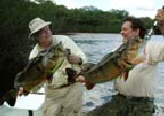
the trip. Mauro captured a 15 pounder (31 inch length and 19 ½ inch girth) on the Jerkin' Sam topwater
lure. About 20 minutes later, I hooked another giant of 16 pounds that ran into the trees near the flooded
shore and out into the main body before being subdued. The fish measured 31 ½ inches long and had a 20 ½ inch girth.
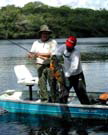 Two minutes later, Wellington hooked and eventually landed a 13 pounder on a
standard size, 6 ¾-inch long Luhr-Jensen Magnum Woodchopper. The following day found us catching additional 13 and 14 pounders and many in the 9 to 12 pound
category. Each day, we each caught between 12 and 15 and lost a few of the very largest. We had several other "atocques" or strikes on our topwaters. Two minutes later, Wellington hooked and eventually landed a 13 pounder on a
standard size, 6 ¾-inch long Luhr-Jensen Magnum Woodchopper. The following day found us catching additional 13 and 14 pounders and many in the 9 to 12 pound
category. Each day, we each caught between 12 and 15 and lost a few of the very largest. We had several other "atocques" or strikes on our topwaters.
On the final day, we ventured upstream toward Santa Maria and beyond fishing the numerous lakes and lagoons. Mauro caught and released a 32-inch long 16 pounder
from Lake Peixe Boe and we claimed about 20 others including 10 between 8 and 11 pounds on that short day. Lake Isu produced a couple of big peacocks that pushed 12 pounds each.
Quick Releases & Giants
Not all action resulted in a successful catch though. One "upper teen" broke my line in open water at Lake
Isu, and two similar fish powered their way to the flooded trees and cut my 100-pound test braid. A fourth
giant peacock tore the rear hooks from one of my slightly abused Woodchoppers. I saw all of the fish and estimated them to be the 16 to 20 pound category.
Much bigger fish do exist in the area. Wellington notes that he has seen peacock bass weighing 14 kilos,
or 29 ¾ pounds, speared by local Indians. In fact, he decided to start his peacock bass operation on the
Xeriuini when he saw one that size in the village of Terra Preta. Both Mauro and Wellington have taken 20 pounders from the area.
There are plenty of botos or freshwater dolphin in the river to view, and a few manatees can be seen on
occasion; we saw two on our trip. There were the typical jacare or alligator on some lagoons and colorful
birds such as macaws, parakeets, king fishers, heron and patos ducks patrolled the skies above the jungle canopy.
For more information on peacock bass, go to www.peacockbassassociation.com, and check out our book store for special savings on 3 peacock bass books!
|